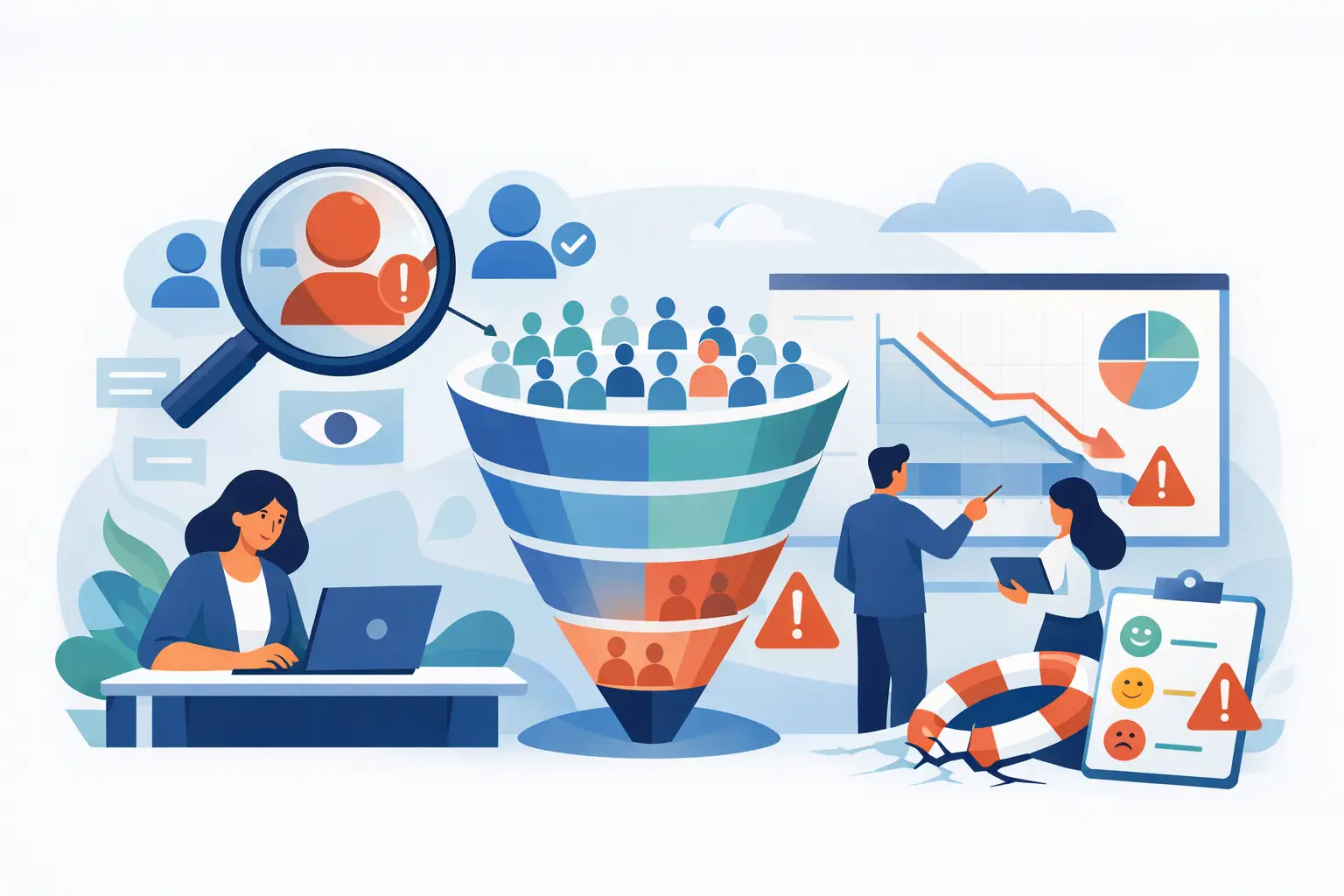
A renewal rarely dies in the renewal call. It usually dies 60, 90, or 180 days earlier, when usage slips, champions go quiet, tickets pile up, and nobody on the team sees the full pattern fast enough. If you want to know how to identify at-risk customers, stop waiting for obvious churn language. By then, you are late.
For lean SaaS teams, that delay gets expensive fast. A customer success manager with a full book of business cannot manually inspect every account every week. Founders and revenue leaders cannot sit in endless account review meetings hoping someone spots trouble. You need a cleaner system than spreadsheets, guesswork, and generic health scores that tell you everything is fine until revenue disappears.
How to identify at-risk customers without guessing
The job is not to collect more data. The job is to recognize which signals actually predict renewal risk and which ones just create noise. Most teams already have enough raw information. They are missing prioritization, timing, and context.
An at-risk customer is not just an unhappy customer. Risk shows up in different ways. Some accounts are disengaging from the product. Some are not getting value quickly enough. Some are expanding politically inside the business while the original champion loses influence. Others look active on the surface but are stuck in shallow usage that never converts into dependency.
That is why simple vanity metrics fail. Logging in once a week does not equal customer health. A high NPS score from six months ago does not protect a renewal. Even a busy support relationship can be misleading - frequent tickets may reflect engagement, or they may signal a product experience that is wearing the customer down.
The right approach is to evaluate behavior over time, not in isolation. Patterns beat snapshots.
The signals that matter most
Product usage is still the clearest place to start, but not all usage signals are equal. Login count alone is weak. You want depth, consistency, and breadth. Is the account using the core workflows that create stickiness? Has adoption spread across multiple users or teams? Are they completing actions tied to real outcomes, or just touching the surface?
A customer who logs in less often but consistently uses high-value features may be healthier than an account with many casual users doing low-value tasks. That distinction matters. Good retention analysis tracks whether usage aligns with realized value, not just activity volume.
Engagement outside the product matters too. If executive check-ins are missed, training invites get ignored, QBRs keep slipping, and your main contact starts replying two days later instead of two hours later, risk is building. Silence is often more dangerous than complaints. Complaints at least give you something to work with. Quiet disengagement is where churn hides.
Support data also deserves a closer read. A spike in unresolved tickets, repeated issues around the same workflow, or rising time-to-resolution can all point to frustration. But support volume alone is not enough. A demanding strategic account may open a lot of tickets and still renew happily. The real signal is whether support friction is increasing while product value is flattening or falling.
Commercial indicators matter as well. Has headcount been reduced at the customer? Did they delay procurement on a separate initiative? Is a contract amendment taking longer than usual? Did a previously engaged buyer suddenly ask for usage reports, export options, or pricing breakdowns? None of these alone confirms churn, but together they often tell a very clear story.
Build a risk model around change, not static scores
One of the biggest mistakes SaaS teams make is assigning a health score and treating it like a stable truth. Customer health is not static. It moves. Fast.
A better model tracks direction. Is usage trending down over 30 days? Are fewer stakeholders engaging this quarter than last quarter? Has time-to-value stretched for newly launched modules? Are support issues becoming more severe? Trend lines are usually more useful than point-in-time values because churn is a process, not a moment.
This is especially important for larger accounts. A big customer can absorb weak signals for months before anyone feels pain. The contract is still active. Meetings still happen. The logo still looks safe on the slide. Meanwhile, power users have dropped off, admins are frustrated, and adoption is shrinking to one team. If your model only checks static account status, you miss the decay.
The practical fix is to score movement. Reward positive trend shifts. Penalize negative ones. Treat sudden behavior changes as escalation triggers, even if the absolute numbers still look acceptable.
What your scoring logic should include
For most B2B SaaS teams, the strongest scoring inputs come from five areas: product adoption, stakeholder engagement, support friction, success milestone completion, and commercial risk. The exact weighting depends on your model, contract structure, and customer segment.
A startup selling a low-ACV self-serve tool may lean heavily on usage frequency and feature adoption. An enterprise platform with annual contracts may care more about multi-threading, executive sponsorship, implementation progress, and procurement behavior. It depends on how your customers realize value and how they typically churn.
That is the point many teams skip. They copy a generic health score template instead of modeling the behaviors that actually precede loss in their own business.
Segment before you diagnose
If you apply one churn model to every account, you will create false positives and false confidence at the same time.
New customers should not be evaluated like mature customers. An onboarding account with incomplete setup may be normal at day 14 and alarming at day 60. A power user account in month 24 should be measured against expansion potential and workflow depth, not activation milestones. Likewise, SMB and enterprise customers often show risk differently. Smaller accounts may churn through silent inactivity. Larger ones may stay active right up until a political or budget shift kills the renewal.
Segmentation makes your signals more honest. Break your base into meaningful groups - by lifecycle stage, customer size, use case, or product tier - and define what healthy behavior looks like for each. That one change alone makes risk detection much sharper.
Why manual account reviews fail
Manual reviews sound responsible. In reality, they are often slow, inconsistent, and full of bias.
A CSM remembers the loudest account, not necessarily the riskiest one. A founder gets pulled toward strategic logos even when mid-market churn is quietly stacking up. Teams overvalue recent conversations and undervalue behavior trends that have been deteriorating for weeks. And by the time everyone gets in a room to discuss the problem, the problem is older than it looks.
This is where automation matters. Not because dashboards are exciting, but because people are busy and churn does not wait. The fastest teams use automated health monitoring to flag changes as they happen, not after a quarterly review cycle. They do not ask CSMs to babysit dozens of signals manually. They surface the few accounts that need action now.
That is the real operational advantage. Speed beats ceremony.
How to identify at-risk customers early enough to act
Early detection only matters if it changes what your team does next. Once an account is flagged, the response should match the type of risk.
If adoption is weak, the fix may be training, workflow redesign, or tighter onboarding. If stakeholder engagement is shrinking, you may need to rebuild the relationship map and find a stronger internal champion. If support pain is driving the issue, the account likely needs product attention, not another check-in email. If commercial risk is rising, renewal planning should start earlier and involve leadership sooner.
This is where many tools fall apart. They can label an account red, yellow, or green, but they do not tell your team what is actually wrong. A useful system does more than score. It points to the drivers behind the score so action is specific and fast.
For lean teams, that clarity is everything. You do not need more dashboards. You need fewer blind spots and faster prioritization. That is why platforms like Churn Assassin focus on behavior, timing, and actionable risk signals instead of bloated customer success workflows that create more admin than outcomes.
What good looks like
A solid at-risk customer process is boring in the best way. Signals are tracked automatically. Risk thresholds are clear. Segment logic is defined. Teams know which triggers require outreach, escalation, or executive involvement. Account reviews become faster because you are discussing real movement, not opinions.
Most importantly, you stop treating churn as a surprise. Some customers will still leave. That part is unavoidable. But if you can see the pattern months earlier, you gain options. You can intervene, reprioritize, or at least forecast accurately enough to protect the business.
That is the payoff. Not prettier reporting. Not another health score no one trusts. Just earlier visibility, better decisions, and more renewals that do not slip away quietly.