Most SaaS teams do not have a customer success problem. They have a visibility problem.
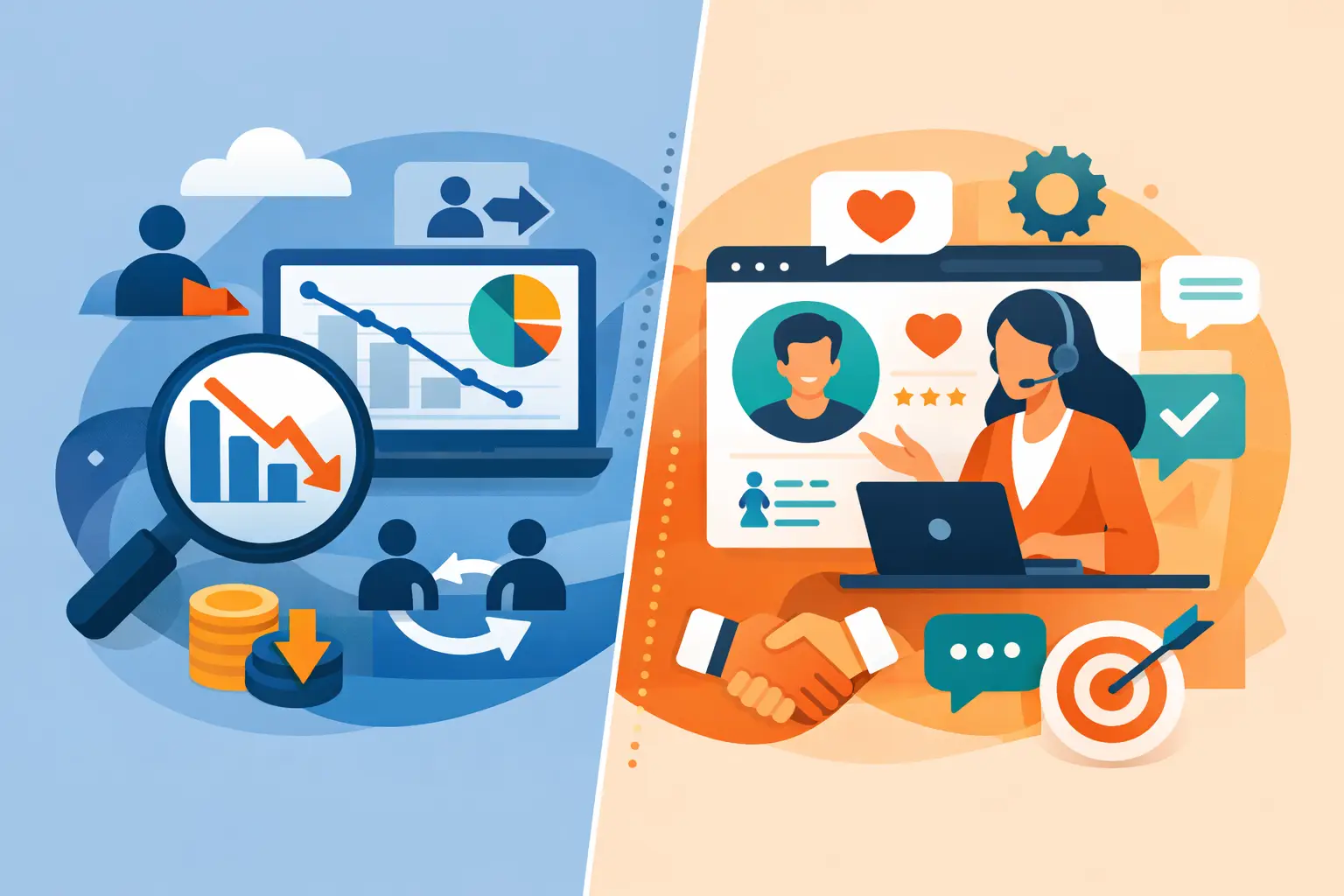
That is the real debate in churn analytics vs CS platforms. One category is built to tell you which accounts are slipping before the renewal gets ugly. The other often tries to run the whole customer success operation - workflows, books of business, tasks, playbooks, notes, and reporting - whether you need all of that or not. If your team is lean, under pressure, and tired of finding churn risk too late, that difference matters.
What churn analytics vs CS platforms really means
On paper, the comparison sounds simple. In practice, these tools solve different jobs.
Churn analytics tools are designed to detect risk, score health, track behavioral change, and surface the accounts most likely to churn or expand. Their value is speed to signal. They pull product usage, engagement, support, and account data into one place and turn it into something a revenue or CS team can act on fast.
CS platforms are broader operating systems for customer success teams. They usually include account segmentation, task management, lifecycle workflows, success plans, playbooks, renewal processes, meeting records, and dashboards. Some include health scoring and predictive signals, but that is often one module inside a much larger system.
That is why churn analytics vs CS platforms is not just a feature checklist. It is a question of whether you need a specialized warning system or a full administrative layer for your CS org.
Why many SaaS teams buy too much software
A lot of companies start with a real pain point: churn feels reactive, account reviews take forever, and nobody trusts the spreadsheet-based health score. Then they buy a heavyweight CS platform because it looks comprehensive.
Comprehensive can also mean slow, expensive, and hard to maintain.
If your team has 5 CSMs, a RevOps function, implementation resources, and the appetite to redesign process, a broad CS platform may make sense. If you are a founder-led SaaS company or a lean post-Series A team trying to stop surprise churn, that same platform can become another system people update instead of another system that drives action.
This is where the market gets messy. Many companies do not need more workflows. They need earlier warnings, cleaner prioritization, and less manual effort.
Churn analytics wins when the problem is late detection
If you are discovering risk in QBR prep, renewal calls, or last-minute Slack threads, your issue is not a lack of customer success theater. Your issue is delayed signal detection.
A churn analytics platform focuses on the signals that usually matter first: declining product adoption, reduced login frequency, weaker feature depth, lower stakeholder engagement, support friction, usage drop after onboarding, and account-level behavior shifts over time. Good systems do not just display those inputs. They interpret them and rank urgency.
That changes the operating model.
Instead of reviewing every account the same way, your team can focus on the few that actually need intervention. Instead of forcing CSMs to maintain manual health scores, you let behavior do the talking. Instead of waiting for a renewal date to create urgency, you get months of lead time.
For lean teams, that is a major advantage. It cuts noise. It reduces admin. It helps one CS leader or a small team cover a larger account base without guessing where to spend time.
CS platforms win when process control is the priority
There are cases where a full CS platform is the right call.
If your business runs a mature customer success function with formal onboarding programs, detailed success plans, complex renewal coordination, handoff workflows, and multiple team dependencies, then operational control matters. A CS platform can standardize how work gets done across the team.
It can also create consistency for larger organizations where leaders want process visibility as much as customer visibility.
But there is a trade-off. The broader the platform, the greater the implementation burden. More objects to configure. More fields to define. More workflows to maintain. More internal training. More cleanup. More chances for the system to drift from reality because the team stops feeding it properly.
That is the core tension in churn analytics vs CS platforms. Broad systems can improve process discipline, but they often create operational drag. Specialized systems can move faster and produce clearer risk insight, but they may not replace every workflow tool in your stack.
The real buying question: insight or infrastructure?
Most buyers get pulled into demo theater and lose sight of the actual decision.
Ask a simpler question: do you need better insight, or do you need more infrastructure?
If the business is missing renewals because nobody sees churn coming early enough, insight is the bottleneck. If the team already sees risk clearly but cannot execute onboarding, adoption programs, or renewal workflows consistently, infrastructure may be the bottleneck.
That distinction matters because buying infrastructure to solve an insight problem is a classic SaaS mistake. You end up with more dashboards, more process, and still no confidence about which customers are in trouble.
Where churn analytics vs CS platforms gets expensive
Software cost is only part of the picture.
A bloated CS platform can demand months of setup, internal ownership, data mapping, process redesign, and ongoing administration. That overhead does not always show up in the line item, but your team feels it. CSMs spend time updating records. Leaders spend time rebuilding reports. RevOps gets pulled into maintenance. Adoption drops, and then everyone quietly goes back to spreadsheets for the real account review.
A focused churn analytics approach usually has a narrower job and a faster time to value. That matters when retention pressure is immediate. You want risk visibility this quarter, not after a six-month rollout.
That does not mean every churn analytics product is automatically better. Some are shallow, noisy, or too dependent on incomplete data. But when the product is built well, the economics are hard to ignore: less setup, less overhead, faster prioritization, and earlier intervention.
What to look for in a churn analytics platform
If you are leaning toward the analytics side of churn analytics vs CS platforms, do not settle for a glorified dashboard.
You want a system that turns behavior into action. That means health scoring based on real account signals, predictive risk detection, trend tracking over time, and account prioritization your team can trust. It should help you see which customers are slipping, why they are slipping, and who needs attention now.
It should also be simple enough that your team actually uses it. Fast setup matters. Clear outputs matter. If it takes an operations project to make the tool useful, you are back in the same trap.
This is why challenger tools are gaining ground. SaaS teams are tired of buying enterprise complexity just to answer a basic question: which accounts are about to churn?
What to look for in a CS platform
If you genuinely need a CS platform, be honest about the maturity required to make it pay off.
These tools work best when your team already has defined processes, internal ownership, and the bandwidth to implement them properly. Otherwise, the platform becomes a warehouse for half-finished workflows and stale fields.
Look for fit, not maximum feature count. If the product is trying to be CRM, project manager, BI tool, success planning tool, and retention engine all at once, that can create more noise than value. Breadth sounds impressive in procurement. It is less impressive when your team avoids the system because using it feels like homework.
The best choice for lean SaaS teams
For most lean B2B SaaS companies, the answer in churn analytics vs CS platforms is not philosophical. It is practical.
If your main goal is to reduce churn, protect renewals, and focus the team on the right accounts without adding headcount, start with churn analytics. Get the signal layer right first. Know who is healthy, who is fading, and where intervention will actually move revenue.
Then decide whether you truly need a broader CS operating system.
That sequence is smarter because it solves the expensive problem first. Churn is costly. Surprise churn is worse. A team that can see risk early and act decisively will usually outperform a team buried inside a giant platform with perfect process maps and poor visibility.
That is exactly why platforms like Churn Assassin resonate with fast-moving SaaS teams. They are not looking for more software theater. They want earlier warnings, cleaner prioritization, and a system that works without creating drag.
A good retention stack should make your team faster, not busier. If a tool gives you more fields to fill out than customers to save, you already have your answer. If you want to see how that compares to a traditional CS suite, start with Gainsight vs Churn Assassin, or get a quick feel for lightweight options in best customer success software for small SaaS. If you are ready to evaluate next steps, you can schedule a demo or review pricing to start your 100 day risk free account.