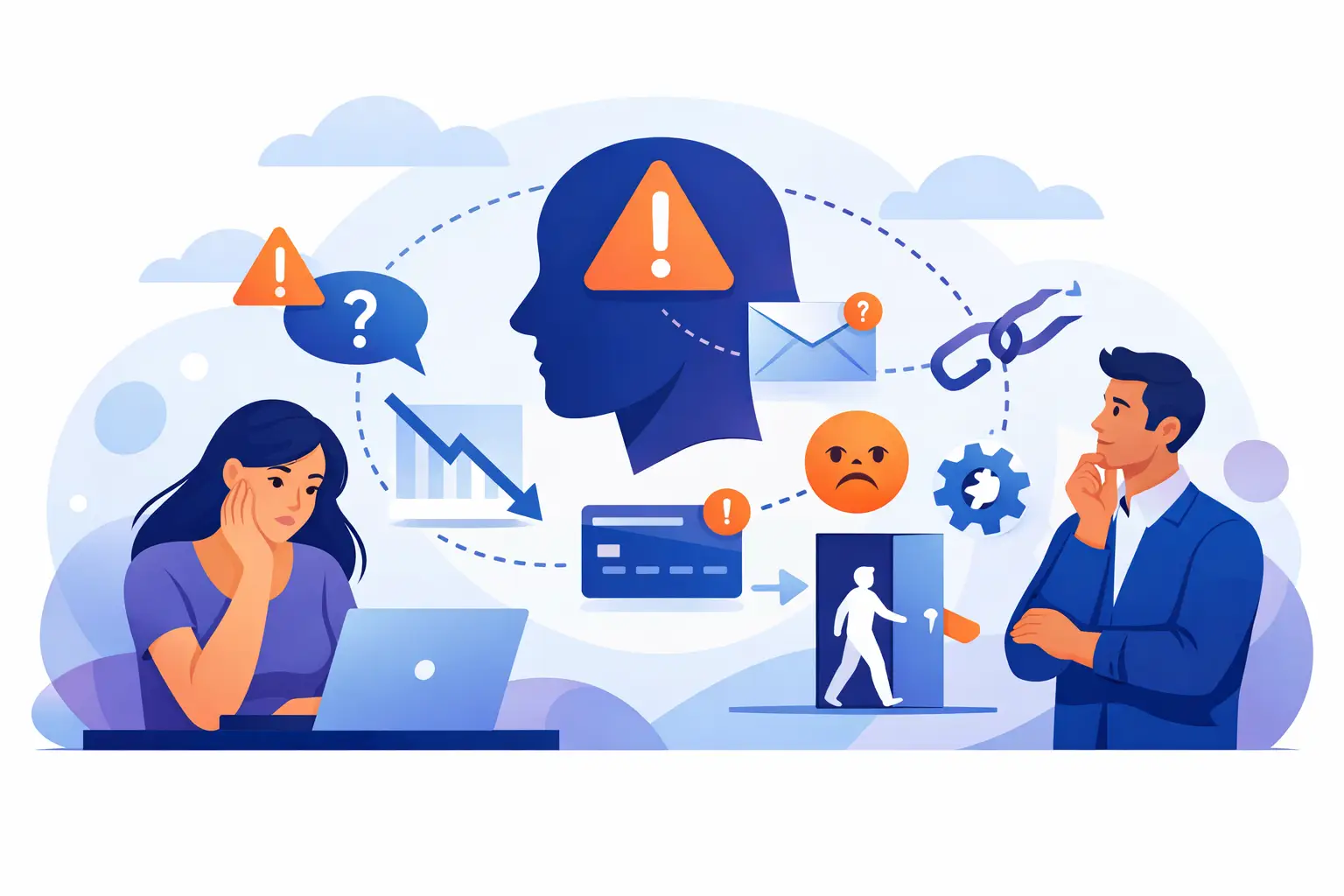
A renewal rarely dies on the renewal date. It usually starts slipping 30, 60, or 120 days earlier, when the account gets quieter, usage narrows, key champions vanish, and nobody on your team has a clean way to separate noise from actual risk. That is why customer churn signals in SaaS matter so much. If you catch them early, you have options. If you catch them late, you are just writing cleaner postmortems.
Most SaaS teams are not short on data. They are short on signal quality. A bloated dashboard might show logins, ticket counts, NPS, and feature clicks, but that does not automatically tell a founder, CS leader, or CRO which accounts are drifting and which ones are fine. Churn prevention gets easier when you stop staring at isolated metrics and start reading account behavior in context, using the churn metrics that actually matter.
What customer churn signals in SaaS actually tell you
A churn signal is not a single event. It is a behavioral clue that an account is losing momentum, value, trust, or internal sponsorship, which is why risk visibility matters. Some signals are loud, like a canceled QBR or a sudden drop in active users. Others are quiet, like a slow decline in admin usage over six weeks.
The mistake is treating all signals equally. One missed login from a low-touch account may mean nothing. The same pattern in a high-value customer with an upcoming renewal and a recent support escalation means something very different. Good churn detection is not about collecting more indicators. It is about weighting the right ones faster than your team can do manually, often with churn predictions.
11 customer churn signals in SaaS teams should not ignore
1. Product usage drops where value is supposed to happen
Not every usage dip matters. Seasonal businesses fluctuate. Some teams use your product monthly, not daily. But when usage falls in the features tied directly to outcomes, risk goes up fast.
If your platform promises workflow automation, reporting, or collaboration, watch the actions that prove that value is happening. A customer can still log in while getting less from the product. That is why vanity activity is weak. Outcome-linked behavior is stronger, and easier to spot with usage trend monitoring.
2. Breadth of usage starts shrinking
A healthy account usually spreads beyond one user or one narrow workflow. When adoption contracts back to a single admin, one department, or one core feature, the account becomes fragile.
This matters because narrow usage is easy to replace. Broad usage creates switching pain. If fewer teams depend on you, the internal case for renewal gets weaker, even if one champion still says things look fine.
3. Executive or champion engagement disappears
A lot of renewals are won or lost based on one person. When your original buyer leaves, goes quiet, or stops attending reviews, an account watchlist helps ensure risk increases immediately.
The trade-off here is obvious. Some mature accounts do not need heavy executive involvement. But if the account has low product depth and your only strong relationship goes silent, that is not stability. That is exposure.
4. Time-to-value stretches after expansion or onboarding
New customers and expanded accounts should show momentum early. If activation takes too long, training gets delayed, or implementation stalls, churn risk starts long before the contract ends.
This is one of the most expensive blind spots in SaaS because teams often label these accounts as too early to judge. In reality, stalled adoption is an early warning. If value is not realized quickly, enthusiasm fades and internal doubt grows, which is why strong customer success fundamentals still matter.
5. Support volume spikes, then goes quiet
A spike in support tickets can mean engagement. It can also mean friction. The real signal is what happens next.
If a customer raises repeated issues around reliability, usability, or data accuracy and then suddenly stops engaging, do not assume the problem is solved. Sometimes they stopped asking because they stopped believing. Silence after frustration is often worse than noise.
6. Meeting behavior changes
Customers tell you a lot with their calendar. They start rescheduling, reducing attendees, skipping business reviews, or showing up unprepared. Those are not admin details. They are commitment signals.
A single canceled call means nothing. A pattern of lower meeting quality across two months, especially near renewal, usually means your account is losing internal priority. If they are not investing time with you, they may not be planning a long future with you either.
7. Feature adoption stalls below the promised use case
A customer might be using your product, but not enough to justify the spend. This happens when accounts stay stuck on basic functionality while the value proposition sold in the deal never gets operationalized.
That gap matters. If the buyer purchased for analytics, automation, or team collaboration and the account only uses one simple module, renewal becomes a pricing conversation instead of a value conversation. That is a dangerous place to be, and exactly where customer health scores can clarify what is actually happening.
8. Negative sentiment shows up before hard metrics move
Sometimes people tell you they are unhappy before their usage reflects it. They question ROI, compare you more often to alternatives, push harder on pricing, or mention internal pressure to cut tools.
Sentiment is messy, which is why many teams underweight it. They prefer cleaner metrics. But churn is a human decision inside a commercial account. If the tone changes, the account has changed, even if your dashboard has not caught up yet.
9. Renewal conversations start too late or stay vague
Strong accounts do not drift into renewal season without a clear story. There is a plan, a budget owner, a use case, and some evidence of success. At-risk accounts tend to enter the period with fuzzy ownership and soft language.
If nobody is discussing goals, outcomes, users, or next-year plans 90 to 120 days out, that is a signal by itself. Hope is not a retention strategy. Late renewal motion usually means your team is reacting to risk instead of managing it, which is why many teams look for retention software that actually works.
10. Account health improves only when your team pushes
Some customers look healthy because your CS team keeps dragging them forward. They attend because you booked it. They adopt because you trained them again. They review metrics because you built the deck.
That can work for strategic accounts, but it does not scale and it can hide weak product pull. If the account has no independent momentum, health is more fragile than it appears. The minute your team backs off, the truth shows up.
11. Billing or contract friction starts increasing
Procurement delays, downgrade talk, payment issues, and requests to reduce seats all belong on your churn radar. Financial friction is not always a churn event, but it often signals reduced confidence or reduced internal demand.
This is where context matters most. Some companies have normal procurement pain. Others use pricing pressure as a negotiation tactic. But when contract friction shows up alongside declining usage or weaker engagement, the pattern is hard to ignore.
Why most teams miss these signals
The common problem is not effort. It is fragmentation. Product data lives in one place, support history in another, CRM notes somewhere else, and health scoring in a spreadsheet that is already outdated by the time the weekly account review starts.
That setup creates two bad outcomes. First, teams react late because no one can see the full picture fast enough. Second, they waste time debating whether an account is actually at risk instead of deciding what to do next. Manual churn detection is slow, inconsistent, and expensive.
This is also why simplistic health scores fail. A green-yellow-red status without behavioral weighting is just a cleaner spreadsheet. It might look organized, but it still leaves your team guessing—especially if you have not invested in health scoring that holds up in practice.
How to use churn signals without creating more operational drag
Start by separating strong signals from weak ones. A login count on its own is weak. A drop in multi-user feature adoption, combined with champion silence and a stalled onboarding milestone, is strong. Risk should be based on stacked evidence, not isolated events.
Next, weight signals by account context. Segment matters. Contract size matters. Lifecycle stage matters. An onboarding delay in month one and a usage decline in month ten do not mean the same thing. Good retention teams do not just monitor behavior. They interpret it against what should be happening at that stage of the customer journey.
Then make the output useful. Your team does not need more dashboards. They need prioritization. Which accounts need immediate intervention, which need monitoring, and which are healthy enough to leave alone. If your system cannot answer that quickly, it is adding noise—this is where account prioritization becomes the difference between action and analysis.
This is where a lean retention intelligence setup beats a heavyweight customer success platform. The goal is not to build a prettier control room. The goal is to spot risk early enough to change the outcome. Churn Assassin is built around that logic - fewer manual reviews, earlier visibility, and signals tied to action instead of dashboard clutter, especially for teams comparing tools like Gainsight vs Churn Assassin.
The real value of early churn detection
The point of tracking churn signals is not to prove you were right after a customer leaves. It is to buy time. Time to rebuild sponsorship, drive adoption, fix a broken experience, or reshape the commercial conversation before procurement gets involved.
Some accounts will still churn. That is reality. But a lot of preventable churn happens because the warning signs were obvious in hindsight and invisible in the workflow. The teams that outperform on retention are usually not doing magic. They are seeing risk sooner and acting while the account is still recoverable—which is why it helps to understand how Churn Assassin works before you operationalize it.
If you want fewer renewal surprises, stop waiting for customers to announce they are unhappy. The signal almost always shows up first in their behavior, so bring it into the open with a demo and align the commercial side early using pricing that matches your retention motion.