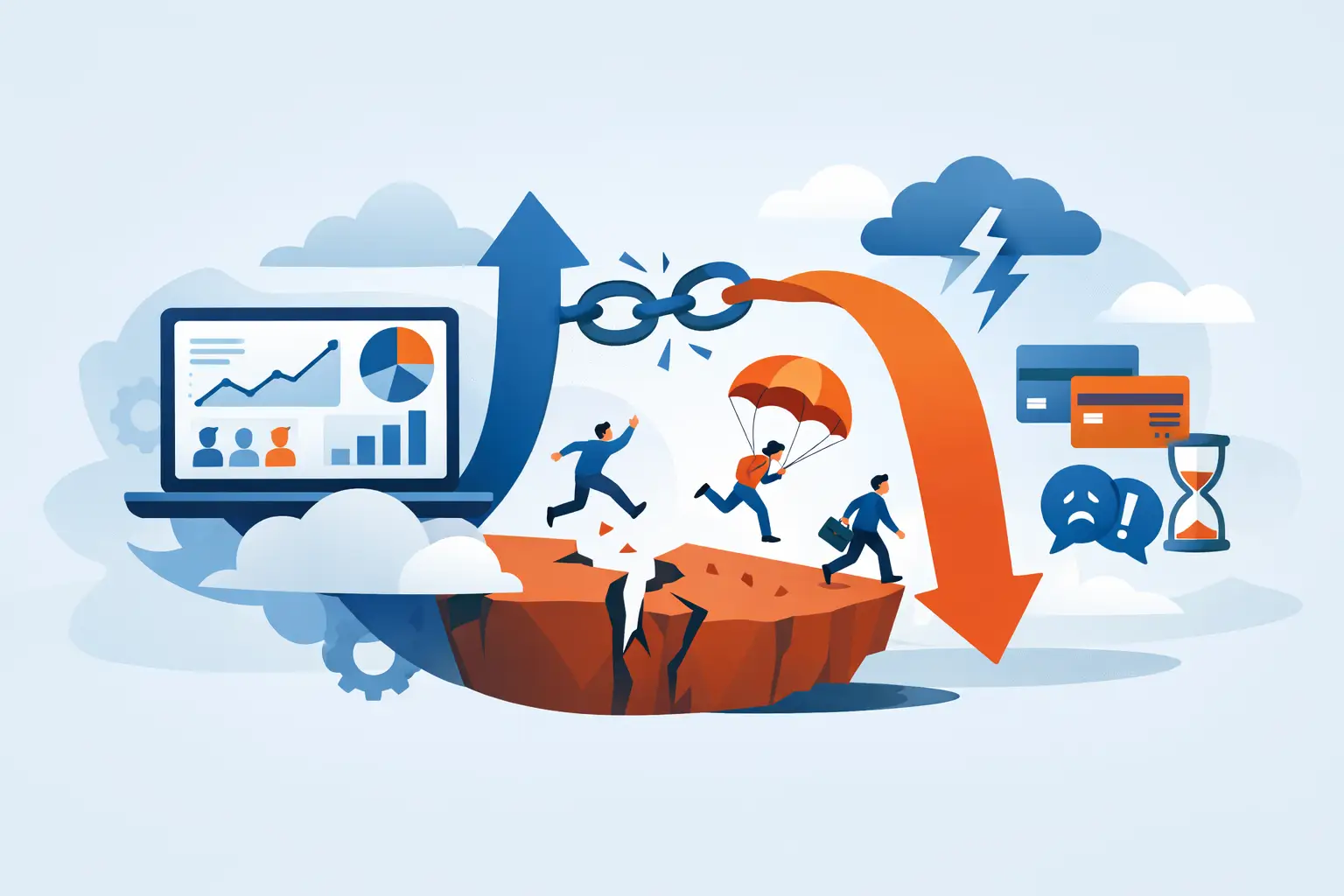
A customer tells your CSM everything looks fine. The renewal is still 90 days out. Product usage is down a little, but not enough to trigger panic. Then the account churns anyway.
That is exactly why so many teams keep asking what causes churn in SaaS - because churn rarely shows up as one dramatic event. It builds quietly through behavior shifts, stalled adoption, weak value perception, and internal customer changes that most teams catch too late. If your retention process still depends on spreadsheets, gut feel, and a last-minute renewal scramble, you are not tracking causes. You are documenting losses.
What causes churn in SaaS most often?
In B2B SaaS, churn is usually the result of a widening gap between what the customer expected and what they are actually getting. Sometimes the gap is product-related. Sometimes it is commercial. Often it is operational. Either way, the pattern is the same: the account stops moving forward long before the contract ends.
The hard truth is that churn is rarely caused by a single bad call, one missing feature, or one support ticket. Most lost accounts show a stack of warning signs months in advance. The problem is not that the signals do not exist. The problem is that many teams are still too reactive to act on them early.
1. Poor onboarding creates weak foundations
A messy onboarding experience is one of the fastest ways to create future churn. If customers do not reach first value quickly, they start the relationship with doubt. That doubt compounds when implementation drags, stakeholders lose interest, or key workflows never get configured properly.
This matters even more in B2B SaaS, where adoption often depends on multiple users, teams, or systems. If onboarding leaves too much work on the customer side, momentum drops. Once momentum drops, usage becomes uneven. Then renewal risk starts building before the account is even fully live.
Not every customer needs a white-glove rollout. But every customer needs a clear path to value. The trade-off is simple: the more friction you leave in the early journey, the more retention pressure you create later.
2. Customers never fully adopt the product
You do not keep accounts just because they signed. You keep them because your product becomes part of how they operate. If only one champion logs in while the rest of the team ignores the platform, your footprint is fragile.
Low adoption does not always look like zero usage. Sometimes it looks like shallow usage. Customers may log in regularly but only use one feature, ignore high-value workflows, or fail to embed the product into day-to-day decisions. On paper, the account looks active. In reality, it is replaceable.
This is where a lot of SaaS teams get fooled by vanity metrics. Login volume alone is not health. Real health means the right users are doing the right things often enough that leaving would be painful.
3. The value is not obvious enough
One of the biggest answers to what causes churn in SaaS is simple: customers stop believing the product is worth the price. That does not always mean the product is weak. It often means the value is not visible, measurable, or consistently reinforced through customer health scores.
If your buyer has to explain the ROI internally every quarter, you have a retention problem. If your product helps, but the impact is fuzzy, you have a retention problem. When budgets tighten, vague value gets cut first.
This is especially dangerous in mid-market and enterprise accounts where economic buyers are not always daily users. The team may like the product, but if leadership cannot clearly see business impact, renewal becomes vulnerable. Great retention depends as much on proving value as delivering it.
4. Product experience friction wears customers down
Not all churn is caused by missing features. A lot of it comes from friction customers get tired of tolerating. Slow performance, confusing workflows, unreliable data, too many clicks, poor integrations, and recurring bugs all chip away at trust.
Any one issue might seem manageable. Together, they create a product that feels expensive to use. And once a customer starts feeling like your software is work, not leverage, the relationship changes fast.
There is a trade-off here. Fast-growing SaaS companies cannot fix everything at once. But they do need to know which friction points correlate with declining health by using product usage analytics. Otherwise product teams optimize for loud feedback while silent churn keeps spreading across the base.
5. Customer success gets involved too late
A lot of companies do not have a churn problem. They have a timing problem.
By the time an account review flags a risk, usage has been dropping for weeks, stakeholder engagement has already faded, and the renewal is too close for a meaningful recovery plan. The team reacts with calls, emails, and discounts, but the account has already mentally moved on.
Reactive customer success is expensive and unreliable. It depends on human memory, inconsistent account reviews, and whatever your CSM happened to notice. That model breaks even faster as your book of business grows.
This is where lean teams get hit hardest. They do not need more meetings or another bloated system. They need earlier visibility into risk, based on behavior instead of guesswork with risk visibility. Churn Assassin exists for exactly that reason - to catch deterioration before it becomes a lost renewal.
6. The wrong customer was sold in the first place
Some churn starts before the contract is signed. When sales brings in accounts that are a poor fit, retention inherits a problem it cannot fully solve.
Maybe the customer was too small, too immature, missing a critical use case, or expecting a level of service the business cannot support. Maybe the deal closed on promised outcomes the product was never built to deliver. In all of those cases, churn is not surprising. It is delayed mismatch.
This is why blaming churn entirely on customer success is lazy. Retention is shaped upstream by positioning, qualification, pricing, onboarding design, and product-market fit. If acquisition quality is weak, renewal performance will keep paying for it.
7. Champions leave and relationships collapse
In B2B SaaS, accounts do not churn. People churn. Then accounts follow.
A strong internal champion can carry adoption, defend budget, and keep the product visible inside the organization. But when that person leaves, changes roles, or loses influence, your foothold can disappear overnight. If the relationship was concentrated in one contact, you are exposed.
This kind of churn risk is easy to underestimate because the account may still look stable in usage data for a while. But internal sponsorship is often what protects the renewal when procurement starts asking hard questions. Without that support, even a useful product can get cut.
The fix is not just relationship-building theater. It is multi-threading the account early, expanding usage across teams, and making sure value is visible beyond one enthusiastic buyer by using an account watchlist.
8. Pricing pressure changes the renewal math
Sometimes customers like the product and still churn. Why? Because the economics changed.
Maybe they are consolidating vendors. Maybe leadership froze spend. Maybe a competitor undercut pricing. Maybe usage-based pricing spiked faster than expected and created tension. In each case, the product itself may not be the issue. The account simply no longer sees the deal structure as sustainable.
This is where retention gets nuanced. Not every price objection is really about price. Some are value objections in disguise. Others are budget reality. The job is to tell the difference early, not wait until procurement weaponizes it at renewal.
Teams that monitor health well can usually see commercial churn coming. Shrinking usage, weaker engagement, slower response times, and reduced stakeholder activity often show up before the pricing conversation gets explicit.
9. You are tracking too few signals
The final reason churn happens is operational blindness. Many SaaS teams rely on a tiny set of lagging indicators: NPS, support tickets, renewal stage, and a manually updated health score nobody fully trusts.
That is not enough. Churn risk shows up across product usage, feature adoption, engagement depth, user spread, sentiment shifts, inactivity patterns, service interactions, and account-level trend lines. When you track too few signals, you miss the pattern until it is obvious. And obvious is usually too late.
The companies that reduce churn do not win because they care more. They win because they can see deterioration sooner and prioritize action with precision using account prioritization. No bloat. No drag. No delayed account triage.
What causes churn in SaaS teams to miss the warning signs?
Usually, it is not lack of effort. It is lack of systemization.
Founders, CROs, and CS leaders know churn matters. But without consistent monitoring, risk detection becomes anecdotal. One CSM has great instincts. Another misses slow-moving accounts. Leadership gets updates in QBRs, not in real time. By then, the damage is already sitting in the renewal forecast.
This is why churn prevention is less about heroic saves and more about operational discipline. The best teams define what healthy behavior looks like, monitor deviations early with usage trend monitoring, and act before the customer starts shopping alternatives.
If you want fewer surprise churns, stop treating retention as a renewal-stage activity. Start treating it as an always-on signal problem with churn predictions. The accounts that leave usually tell you first. You just need a better way to hear them. If you want to see Churn Assassin in action, schedule a demo or review pricing.